

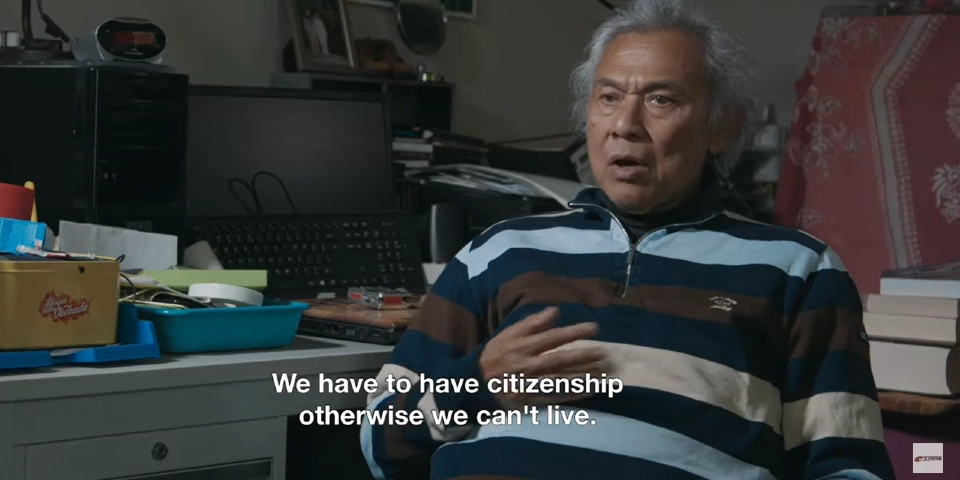
An old man had a banana tree planted in their home, ten-thousands of kilometers away from a small village which once offered him a sense of warmth and familiarity during his childhood. The tree symbolized his longing for the country he was born in. Another old man stored hundreds of books in a small room he had to refer to as a ‘home’, as he was exiled from his own. Multiple similar stories of the exiles were compiled and thoroughly explained in the 119-minutes duration of ‘Eksil (The Exile)’.
‘Eksil (The Exile)’ was a documentary directed by Lola Amaria chronicling the lives of Indonesian exiles living abroad, unable to return to their birthplace for reasons explained later on in the film. The documentary shows a brief history of the Indonesian Communist Party (Partai Komunis Indonesia / PKI). It also mentioned their influence and strength as a political party during their peak; and the hunt for PKI members and associates that followed the events of the 30 September Movement (Gerakan 30 September / G30S). Most importantly, it showed stories of Indonesian individuals who, in their golden years, yearned to go back to their homeland after decades of exile.
A Change in the Ripple
The documentary was released in November 2022, premiered in the JAFF Indonesian Screen Awards competition program and won. It won another film festival in March of the following year, before finally seeing a limited theatrical release in February of 2024. Despite the limited screening and minimal marketing it had, the movie garnered astounding numbers of viewership. It had stayed in cinemas for an unprecedented amount of time despite being a documentary. An exception to the usual Indonesian cinema roster of horror, comedy, and blockbuster movies.
Lola Amaria directed and framed ‘Eksil (The Exile)’ in a way where the exiles whose stories were being told held their politics and wore it on their sleeves. For some, the strong beliefs they had was what prevented them from going home to Indonesia. They refused to denounce their support for the ousted former president and founding father Soekarno, which in turn stripped them of their Indonesian citizenship and left them stateless, forced to seek sanctuary.
The exiles shown held no ill wills or in any way regretted their association with the party. Nor did they harbour a hatred towards the country that seemed to fail them in every turn and effort of reconciliation. Lola showed that beyond their politics, they were once students who left the country to study with the goal of bringing the land they loved one step closer to prosperity. But were turned away and left to fend for themselves.
Read more: Four Fundamental Critics of the Inadequate Implementation of Law on Sexual Violence Crimes
These exiles had a banana tree planted in their home that reminded them of the village they spent their childhood in. They compiled the history and stories of other exiles in their home library, papers strewn about and covered more space than the inhabitant took with his aging frame. They gave Indonesian students a shelter and place to call home in a continent seas away. The extent of their love for Indonesia, despite their citizenship status was the focus of the movie, is a show of humanity that contrasted the image of a brutal and extremist group eager to usurp power and strongarm Indonesia into a communist country shown in a familiar propaganda film.
This is not to say that the film is not a form of propaganda or wholly unbiased. It shows its biases clearly enough, as do the focal points of the documentary, the exiles themselves hold their biases. ‘Eksil’ retells the story of individuals in their host countries in black and white animation, depicting the moment an exile witnessed a fellow student going mad from uncertainty and fear. The moment where an exile and his family were advised not to leave as they would not be protected by their host country or their own. A man turned away from his hometown by his own blood to protect them from the police’s threatening presence that followed them decades after the 30 September Movement; and so forth.
Read more: The Voice of Fatia and Haris were Unstoppable, Finally They were Acquitted
The impact of the sentimental lens shown in the film combined with the very real suffering the exiles went through, were amplified by the common knowledge and understanding the viewers already had; regarding the corruption and violence that permeated throughout the new regime. The previous connotations and framing regarding said regime and PKI experienced a sort of discourse when confronted with the new associations and meaning the film brought to the word “exiles”, allowing for a fresh perspective to be born.
Then Came ‘Dirty Vote‘: A Crack on the Frame
The theatrical release of ‘Eksil (The Exile)’ also happened to fall on a political year in Indonesia. The February show was close to the upcoming Indonesian presidential election that would happen on the 14th of said month. ‘Eksil (The Exile)’ sparked conversations on the social media X (formerly and colloquially known as Twitter) where young adults who started to become more politically literate spread word about the movie. To them, the movie told them a side of the history that the education system never showed and people shied away from.
As the days passed and viewership on the story climbed, on the 11th of February—only three days before the presidential election—a documentary was released. It was ‘Dirty Vote’, which shed light on the corruption surrounding ongoing presidential campaigns and the participating candidates. ‘Dirty Vote’ was released for free on Youtube and ‘Eksil’ still had showings in selected cinemas across the nation. While both movies touched on vastly different topics, both documentaries were ‘bundled’ as a ‘must watch’ for the voters. Especially first-time young voters who might be newly conscious of politics (Lane, 2024).
Read more: ‘Divorce Because of Different Political Points of View Until Sexual Violence’: Women Violence in Election
The thread that seemed to connect the two documentaries was the exposure of a corrupt government and its treatment of its own citizens. ‘Dirty Vote’ spent the whole of its runtime dedicated to exposing certain forms of corruption and measures taken by peoples and parties in order to prepare for the upcoming contentious election. Whereas ‘Eksil’ took a portion of the time it had to show the extent of cruelty the government showed on a portion of its people. Also the profound effects of said corrupt government had on the lives of a certain group, sowing sympathy for those wronged at the hands of the New Order under authoritarian regime. These two were bundled in the hopes that they may sway the opinions of some and cement it for others.
A Learned Trauma
The success of ‘Eksil’ was a marvel, but so was the fact that it had passed screening. It showed that Indonesia had slowly broken free from the grasp of the Orde Baru (New Order) regime and the stigma it perpetuated through its anti far-left propaganda. In efforts to hammer in the trauma the nation felt from the actions of the PKI, the Soeharto government made a film titled ‘Pengkhianatan G30S/PKI’ an essential viewing. Though legally the mandate was lifted in 1998, the practice itself outlasted the New Order regime’s tenure. The showing continued in some institutions even until the 2000s at the tail-end of September, tens of years well after the regime crumbled (Pitaloka & Ardyanto, 2023).
In my own experiences as a student learning history in public schools with curriculums set by the government, the topic of G30S and PKI was a sensitive one—with the usually rowdy class falling uncharacteristically sedate. The mention of PKI, communism, Karl Marx, or even in some cases socialism, was greeted with apprehension and jokes of forced disappearances or imprisonment by the government.
Read more: Continuously Dramas Lead Me to Find My Other Identity
What this showed to me was that the mention of those words that could even be associated with radical leftist ideologies were still considered taboo. Those labels became a brand that people averted. It showed that the language framed around those words as part of Soeharto’s propaganda still persisted, holding sufficient power to stifle conversations and propagation. The study or conversations around it still sparked anxiety. Maybe not for possible arrests or kidnappings, but for the judgement that may come from people who still held the views they were taught in school and echoed throughout their lives.
With the widespread success of ‘Eksil’, it may slowly shake Indonesia free from the haunting remnants of Soeharto’s grasp. Also bringing forth a more tolerant space for discourses to occur; enabling the synthesis of new ideas previously undiscovered behind the curtain of stigma, effectively extending the web of knowledge to lay the foundations for the development of Indonesia without ostracising its intellectuals.
A New Wave
‘Eksil’ itself was born from the director’s curiosity of the full story behind the victims of the 1965 tragedy. Obtained from an interview with Lola Amaria and Media Indonesia (2024), Lola described her experience growing up during ‘Orde Baru’ or the New Order. Back then, she would watch the ‘Pengkhianatan G30S/PKI’ year after year for twelve years. She would then go on to say how “…I never understood the context, but the trauma and fear associated with that group (PKI) left a mark.” She goes on to explain how she started to question what the whole picture looked like as she stepped into highschool. And how that curiosity later on blossomed into the production of this movie and its release in 2022.
During the years prior to the conception of ‘Eksil’, Lola recalled how the various friends she made in university remarked on her interest in learning more about the subject. And the way they would tell her to be careful (Harahap, 2024). The fear and wariness surrounding PKI and communism are still apparent. A survey done by an independent research group SMRC (2020) showed that out of the 1203 respondents, 36% knew about the rumour regarding resurgence of PKI. With 38,7% of them believing said resurgence to actually be happening. Though this ultimately results in a small number, an overwhelming 79% of those who agreed it was happening see it as a threat to Indonesia. This then begs the question: how has this lasting trauma and fear been perpetuated throughout the years?
Read more: The Story of Ria, Tiko, and Erni: The Challenge of Transgender to Have Social Security
The trauma itself is not held by those who are personally affected by the tragedy. Rather, it was instilled into society through the showing of propaganda. It, in this case, was the movie ‘Pengkhianatan G30S/PKI’—a movie whose production was funded by the government of the time (Fakka, 2022). Also whose showings were mandated by the very same government until 1998 (Pitaloka & Ardyanto, 2023). This then shows that the Soeharto’s regime as an institution has the power to control and then define information as it sees fit. The movie then acts as a medium that conveys the evils of PKI. And bakes the feeling of danger and wariness into the PKI, and by extension, communism. This act of defining and transforming of meaning is associated with Michel Focault’s discourse analysis, where languages and actions produce meaning (Martinez, 2016).
Lola Amaria’s documentary, ‘Eksil’, is also part of this discourse. Because the fear and trauma associated with PKI used to be agreed upon and held by a large group of the population, this gives legitimacy to the association between PKI and danger. This notion itself was first built by the institution of the running government, where it used its power to control the discourse surrounding this group. ‘Eksil’ then, as a documentary, acts similarly to the ‘G30S/PKI’ movie. It challenges the current meaning and association held by PKI and those who were part of it. Lola uses her power and the resources she has as a filmmaker to construct a new meaning and introduce a more empathetic view of PKI members. Thus attempting to transform the meaning of the current agreed-upon definition still held by some in society.
References
Fakka, M. A. (2022, September 29). Sejarah Pembuatan Film G30S PKI Karya Arifin C Noer, Habiskan Dana 800 Juta dan Diproduksi 2 Tahun. Tribunnews.com. https://www.tribunnews.com/seleb/2022/09/29/sejarah-pembuatan-film-g30s-pki-karya-arifin-c-noer-habiskan-dana-800-juta-dan-diproduksi-2-tahun
Harahap, D. (2024, March 3). Lola Amaria Jawab Keresahan Sejarah Melalui Film Dokumenter Eksil. Media Indonesia. https://mediaindonesia.com/hiburan/656100/lola-amaria-jawab-keresahan-sejarah-melalui-film-dokumenter-eksil
Lane, M. (2024, March 18). A Cultural Blow to an Eroding Political Taboo: Viewing “Eksil” (The Exiles), a Hit Documentary | FULCRUM. Fulcrum.sg. https://fulcrum.sg/a-cultural-blow-to-an-eroding-political-taboo-viewing-eksil-the-exiles-a-hit-documentary/
Martinez, M. A. (2016, April 26). Foucauldian discourse analysis. Miguel A. Martínez. Professor of Housing and Urban Sociology. https://www.miguelangelmartinez.net/?2018-Foucauldian-discourse-analysis
Pitaloka, P. S., & Ardyanto, S. D. (2023, September 30). Sejak Kapan Film Pengkhianatan G30S/PKI Tak Lagi Wajib Tayang dan Tonton? Seleb. https://seleb.tempo.co/read/1778127/sejak-kapan-film-pengkhianatan-g30spki-tak-lagi-wajib-tayang-dan-tonton
SMRC. (2020, September 30). Sikap Publik atas Isu Kebangkitan PKI [Survey Findings]. SMRC. https://saifulmujani.com/sikap-publik-atas-isu-kebangkitan-pki/
Photo: Youtube Eksil, Official Trailer


